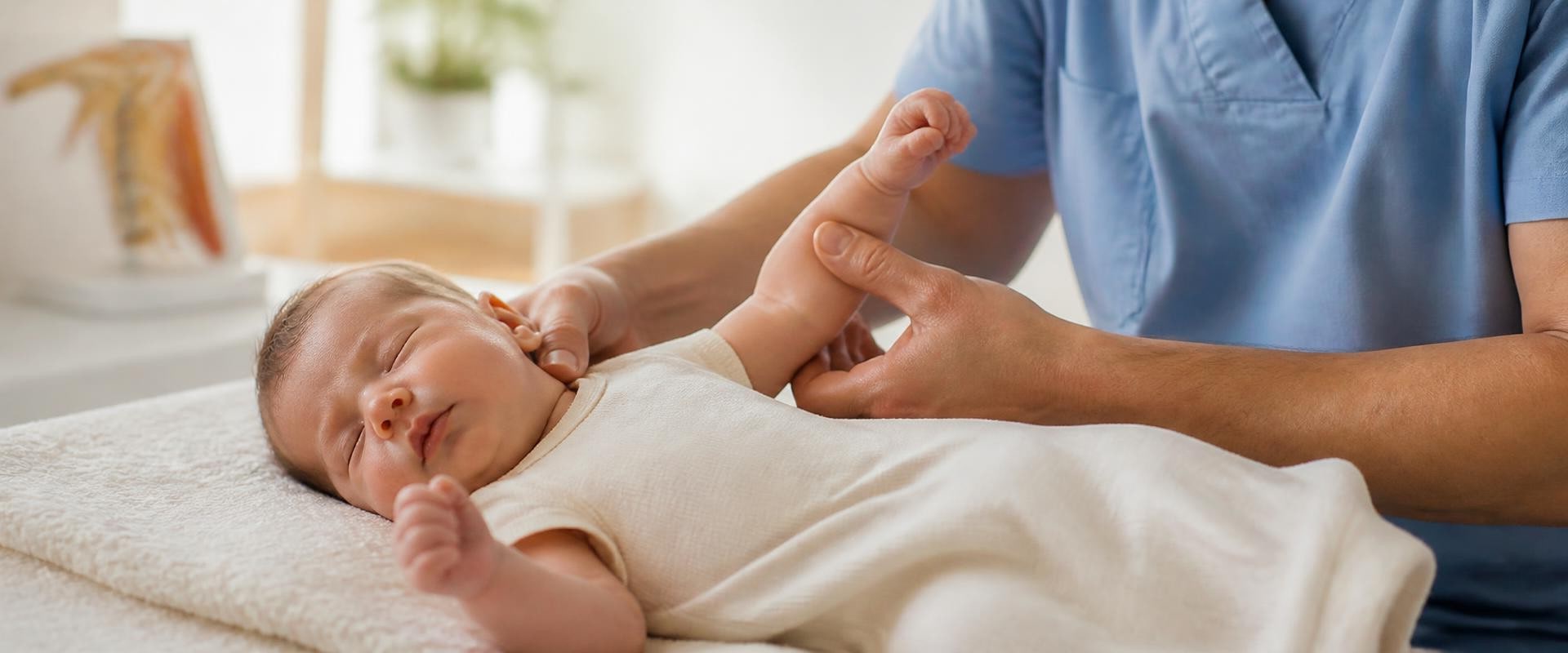
Brachial plexus birth injuries are classified partly by which nerve roots are damaged. Erb's palsy mainly affects the upper roots, Klumpke's palsy involves the lower roots, and global palsy affects nearly or all of the nerve network. These differences influence symptoms, treatment, and recovery.
Why nerve location matters
The brachial plexus controls many different muscles.
Its five nerve roots do not all perform identical functions.
Upper roots contribute to shoulder movement and elbow bending.
Lower roots help control wrist, finger, and hand functions.
When only part of the nerve network is damaged, certain movements may remain intact.
Doctors examine which movements are weak to identify the likely injury pattern.
This helps guide follow-up and specialist care.
Erb's palsy: Upper brachial plexus injury
Erb's palsy typically involves C5 and C6.
These nerves help control shoulder lifting, shoulder rotation, and elbow bending.
A baby with Erb's palsy may hold the affected arm close to the body.
The elbow may remain straight, and the shoulder may rotate inward.
This appearance is often called the waiter's tip posture.
Hand grasp is frequently preserved.
Many babies with mild upper-root injuries improve naturally.
However, severe nerve damage can cause lasting weakness.
Klumpke's palsy: Lower brachial plexus injury
Klumpke's palsy primarily affects C8 and T1.
These nerve roots contribute to hand and finger movement.
A newborn may have reduced grip strength or difficulty moving the fingers.
More extensive weakness can affect wrist function.
A claw-like hand posture may develop in certain cases.
Isolated Klumpke's palsy is uncommon in newborns.
When lower-root injuries are severe, doctors may also look for Horner syndrome, which can indicate associated sympathetic nerve damage.
Global brachial plexus palsy
Global palsy affects the entire or nearly entire brachial plexus.
It may involve all five nerve roots, from C5 through T1.
A baby with global palsy can have profound weakness throughout the shoulder, elbow, wrist, and hand.
The arm may appear almost completely motionless.
These injuries generally have a less favorable prognosis than isolated upper-root injuries.
Specialist assessment is especially important.
Some infants require nerve reconstruction and long-term rehabilitation.
Comparing the three patterns
Injury pattern | Commonly affected nerves | Main functional concern |
|---|---|---|
Erb's palsy | C5-C6 | Shoulder and elbow weakness |
Klumpke's palsy | C8-T1 | Hand and finger weakness |
Global palsy | C5-T1 | Weakness throughout the arm |
Why severity still matters
Two babies with the same injury pattern may recover differently.
One may have temporary nerve stretching.
Another may have a nerve rupture or avulsion.
The underlying tissue damage influences whether spontaneous recovery is possible.
Doctors therefore consider both nerve location and injury severity.
Common questions around brachial plexus injury types
Is Erb's palsy the same as a brachial plexus injury?
Erb's palsy is one type of brachial plexus injury, not the entire category.
Which injury affects the hand most directly?
Klumpke's palsy and global palsy commonly involve significant hand weakness.
Which pattern usually has the most serious outlook?
Global palsy generally carries the greatest risk of lasting functional impairment.