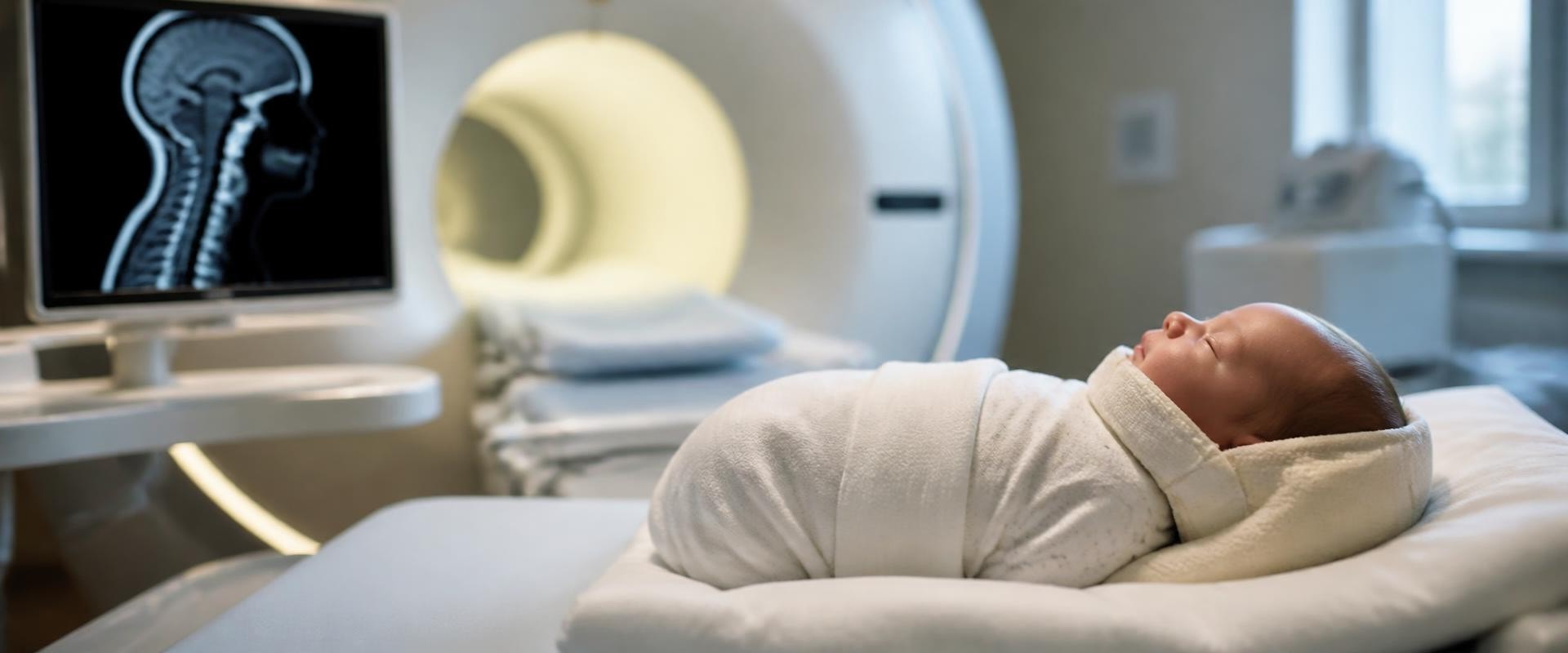
A newborn can experience spinal cord damage even when conventional X-rays show no broken or displaced vertebrae. This pattern is known as spinal cord injury without radiographic abnormality, or SCIWORA. MRI is especially important because it can reveal injury within the spinal cord and surrounding tissues.
What is SCIWORA?
SCIWORA is a term used when a person has clinical evidence of spinal cord injury without corresponding traumatic abnormalities on conventional radiographs.
The term developed before MRI became widely available.
Modern imaging may reveal spinal cord abnormalities despite normal X-rays.
In newborns, this distinction is important because the spine is highly flexible.
The bones and supporting tissues may stretch or move without fracturing.
However, the spinal cord itself may not tolerate the same forces.
Significant neurological damage can occur without obvious skeletal injury.
Why newborn anatomy matters
A newborn's spine differs from an adult's spine.
The supporting structures are more flexible.
The head is also relatively large compared with the body.
These characteristics affect how mechanical forces are transmitted through the neck.
During difficult childbirth, excessive stretching or rotation may place stress on the spinal cord.
The absence of a visible fracture does not rule out injury.
Symptoms that may suggest SCIWORA
A baby may show unusually weak limb movement.
Muscle tone may be reduced.
Reflexes can be abnormal.
Severe cervical injuries may interfere with breathing.
Some newborns show weakness affecting all four limbs.
Others may have more limited neurological findings.
These symptoms can resemble other newborn disorders.
Doctors must consider the complete clinical picture.
Why an X-ray may not be enough
X-rays are useful for identifying certain fractures and alignment problems.
However, they do not directly show the spinal cord in detail.
A normal X-ray cannot establish that the spinal cord is healthy.
MRI provides more detailed information about the spinal cord and surrounding soft tissues.
It may reveal swelling, bleeding, or other changes associated with injury.
How doctors investigate suspected SCIWORA
The first step is a careful neurological examination.
Doctors evaluate spontaneous movement, muscle tone, reflexes, and breathing.
They review the delivery history for possible trauma.
MRI may be recommended when spinal cord injury is suspected.
Other tests may help exclude conditions such as hypoxic brain injury or neuromuscular disorders.
The diagnosis depends on combining clinical findings with appropriate imaging.
Treatment and follow-up
Treatment depends on the severity and location of injury.
The medical team focuses on stabilizing the baby and protecting neurological function.
Respiratory support may be needed for high cervical injuries.
Specialist care may involve pediatric neurology, neurosurgery, rehabilitation, and intensive care.
Some incomplete injuries allow recovery of function.
Severe injuries may cause lasting disability.
Did you know?
The term SCIWORA does not mean that MRI must be normal.
It refers to the absence of certain abnormalities on conventional radiographs, while MRI may show spinal cord damage.
Common questions around SCIWORA
Can a baby have a spinal cord injury with a normal X-ray?
Yes. The spinal cord can be injured without a visible fracture.
Is MRI useful for detecting newborn spinal cord damage?
Yes. MRI can show spinal cord abnormalities that X-rays cannot.
Does SCIWORA always cause permanent paralysis?
No. Outcomes depend on the extent and location of the injury.
For more information, visit: https://birthinjuryadvocate.com/birth-injuries/spinal-cord-injury/


