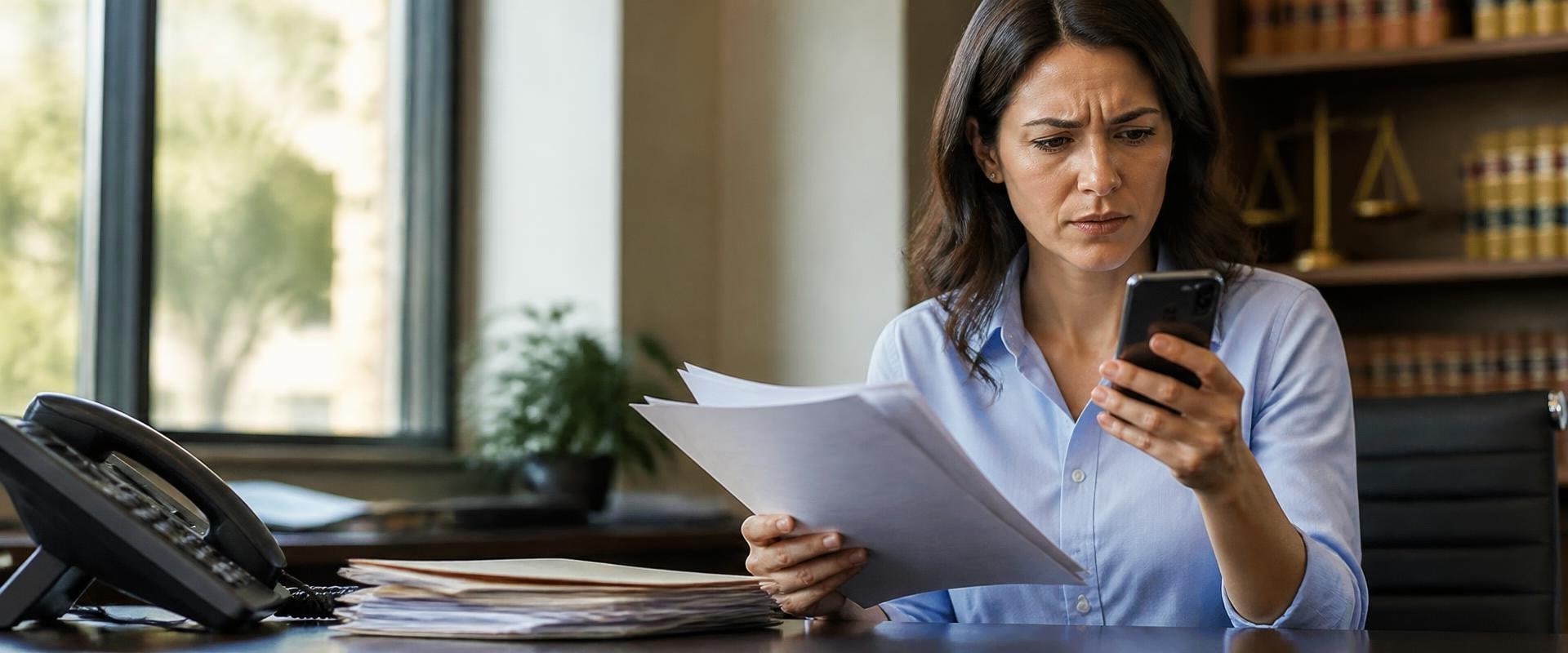
A TCPA lawyer helps consumers investigate unlawful robocalls, unwanted marketing texts, and other communications restricted by the Telephone Consumer Protection Act. Legal representation may involve reviewing consent, identifying responsible businesses, preserving evidence, negotiating settlements, or filing civil lawsuits.
Certain TCPA violations may support $500 in statutory damages, with possible enhanced awards reaching $1,500 for knowing or willful misconduct. However, not every unwanted call creates a legal claim.
A qualified attorney evaluates the specific facts before recommending legal action. This includes determining whether the alleged violation can be proven and whether potential compensation justifies the costs involved.
What does a TCPA lawyer actually do?
An attorney handling telephone privacy cases focuses on whether a communication violates a specific federal or state restriction.
The work begins with a review of the calls, messages, and available documentation.
A lawyer may need to determine whether the communications involved prerecorded voices, artificial speech, automatic dialing systems, or prohibited telephone solicitations.
These categories have different legal requirements.
Investigating the source of unwanted communications
The first challenge is often identifying the business responsible.
A telemarketer may use an outside call center, multiple telephone numbers, or a third-party marketing contractor.
Caller ID information alone may not establish which company initiated the communication.
An attorney can review publicly available business records and, when litigation permits, pursue relevant documents through discovery.
The investigation may involve the seller whose products were advertised and the company that placed the calls.
Reviewing consent and legal defenses
Businesses frequently argue that consumers previously authorized marketing communications.
Permission may have been obtained through an online form, service inquiry, or customer agreement.
A lawyer reviews whether consent was valid under the applicable legal provision and whether it covered the disputed communications.
Requests to stop further contact may also affect the analysis.
Valid consent can defeat some claims, while an effective revocation can change whether later communications are permitted.
How compensation works in TCPA cases
Under 47 U.S.C. § 227(b)(3), certain qualifying violations permit recovery of actual monetary loss or $500 per violation, whichever is greater.
Courts may increase damages up to three times the applicable amount for knowing or willful misconduct.
The private Do Not Call remedy has different requirements and permits damages of up to $500 per qualifying violation before any enhancement.
For example, ten proven section 227(b) violations produce a base statutory calculation of $5,000.
That calculation is not a guaranteed settlement.
The number of actionable communications, available evidence, legal defenses, and defendant's financial circumstances all affect recovery.
Did you know? TCPA cases do not automatically award attorney fees
Unlike some federal consumer protection statutes, the TCPA generally does not require a losing defendant to pay a successful private plaintiff's attorney fees.
Many attorneys therefore offer contingency-fee arrangements.
Under such an agreement, legal fees are typically calculated as a percentage of the recovery.
Consumers should read the written agreement carefully and ask how expenses are handled if the case is unsuccessful.
When should you contact a TCPA attorney?
A review may be useful when repeated calls come from an identifiable business, particularly when the communications involve recorded marketing or continue after relevant stop requests.
Save original voicemails, text messages, and call records.
Information about the date, time, advertised service, caller identity, and consent history helps an attorney assess the claim.
A good initial review should also identify weaknesses.
For example, a claim involving one unidentified live call may be difficult to pursue, while several well-documented prohibited messages from a known business may provide a stronger foundation.
Common questions around TCPA lawyers
Does a TCPA attorney handle spam text cases?
Yes. Certain text message practices fall within TCPA restrictions, although the applicable rules depend on the sending method, consent, and legal provision.
Can a lawyer help identify an unknown caller?
Potentially. Public records and authorized discovery may help identify a legally responsible business.
Do I need substantial financial losses?
Not always. Certain TCPA provisions allow statutory damages without proof of an equivalent monetary loss.
Can a lawyer guarantee compensation?
No. Liability and recovery depend on the facts and applicable law.
How long do I have to file a claim?
Federal TCPA claims are commonly subject to a four-year limitations period.