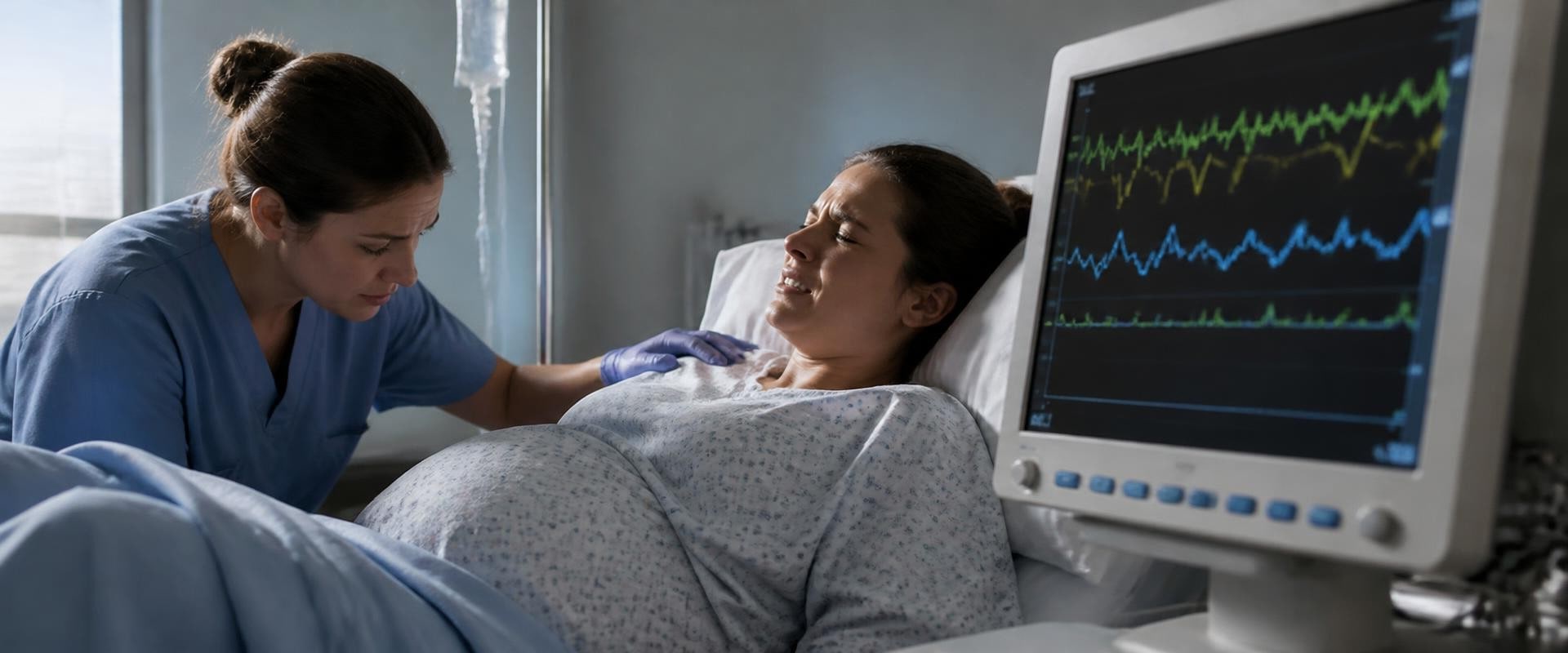
Electronic fetal monitoring helps healthcare professionals assess a baby's condition during childbirth. It records heart rate changes and their relationship to uterine contractions. When doctors or nurses fail to recognize concerning patterns, communicate findings, or respond appropriately, serious complications may follow. Understanding these errors can help families identify potential problems and evaluate the medical care provided during labor.
Understanding fetal monitoring during childbirth
Fetal monitoring is an important part of modern obstetric care. It helps medical professionals evaluate how a baby responds to the physical demands of labor.
Electronic fetal monitoring typically uses sensors placed against the mother's abdomen. One sensor records the baby's heart rate, while another measures the timing of uterine contractions.
The information appears as a continuous tracing on a monitor or printed record.
Clinicians examine the relationship between contractions and changes in the baby's heart rate.
Some fluctuations are expected during normal labor. Others may indicate that the baby requires additional evaluation.
A fetal monitoring error occurs when healthcare professionals fail to obtain reliable information, interpret concerning findings correctly, communicate important changes, or take appropriate action.
These failures may involve an individual clinician, communication between team members, or hospital procedures.
Four features of fetal heart rate monitoring
Healthcare professionals evaluate several characteristics of fetal heart rate tracings.
The baseline heart rate generally ranges from 110 to 160 beats per minute.
Variability describes small fluctuations around the baseline. Moderate variability is usually reassuring because it suggests intact neurological and cardiovascular responses.
Accelerations are temporary increases in the baby's heart rate. Their presence is generally reassuring.
Decelerations are decreases in heart rate that may occur before, during, or after contractions.
Their timing, duration, depth, and relationship to other tracing features help clinicians assess their significance.
A single finding rarely tells the complete story. Medical professionals must interpret the entire tracing alongside the clinical circumstances.
How fetal monitoring errors may contribute to birth injuries
A monitoring error may begin when an abnormal heart rate pattern is overlooked.
For example, a nurse might fail to recognize recurrent late decelerations or worsening variability.
Another problem may occur when a clinician identifies concerning findings but does not communicate them promptly.
Even when the entire medical team recognizes a problem, delayed treatment can place the baby at risk.
Persistent oxygen deprivation may cause neurological injury in severe cases.
One possible outcome is hypoxic-ischemic encephalopathy, commonly called HIE.
HIE involves brain dysfunction associated with inadequate oxygen and blood flow.
Some affected children develop long-term neurological difficulties, although many fetal heart rate abnormalities do not result in permanent injury.
Why delayed intervention matters
The appropriate response to an abnormal tracing depends on its severity.
Clinicians may attempt corrective measures, including repositioning the mother, addressing low blood pressure, or reducing medication that stimulates contractions.
These interventions can improve the baby's condition in some situations.
If serious abnormalities continue, expedited delivery may become necessary.
A failure to reassess the tracing or prepare for delivery can create avoidable delays.
However, not every abnormal tracing requires an immediate cesarean section.
The medical team must consider the entire clinical situation before determining the safest response.
Did you know? Fetal monitoring uses three tracing categories
Fetal heart rate tracings are commonly classified into three categories.
Category I describes reassuring patterns generally associated with normal fetal oxygenation at the time of assessment.
Category II includes patterns that are neither clearly reassuring nor definitively abnormal. These findings require evaluation and continued surveillance.
Category III represents abnormal patterns associated with increased concern for fetal acid-base disturbance.
Persistent Category III patterns require prompt evaluation, corrective measures, and expedited delivery when the tracing does not improve.
Category II can be particularly challenging because it covers many different patterns.
A tracing may remain in Category II while gradually becoming more concerning.
Clinicians must assess trends rather than rely only on a category label.
When monitoring failures may involve medical negligence
A birth injury following abnormal fetal monitoring does not automatically establish malpractice.
Electronic monitoring has limitations, including false-positive findings and differences in clinical interpretation.
A negligence investigation examines whether the medical team responded appropriately to the available information.
Potential concerns include failure to recognize persistent abnormalities, inadequate surveillance, communication failures, or unreasonable delays in treatment.
Hospital staffing and escalation procedures may also become relevant.
The strongest evaluations consider the complete labor record.
Fetal monitoring tracings, nursing notes, physician orders, and delivery records can help establish what happened and when.
Medical experts may then assess whether different care would likely have prevented or reduced the injury.
Common questions around fetal monitoring errors
Can fetal monitoring mistakes cause brain injuries?
In some circumstances, failure to recognize and respond to serious fetal compromise may contribute to oxygen-related brain injury.
Are abnormal fetal heart rate patterns always dangerous?
No. Many abnormalities are temporary or do not indicate serious oxygen deprivation.
Can parents request fetal monitoring records?
Yes. Parents can generally request relevant medical records, including complete electronic fetal monitoring tracings, subject to applicable access rules.
Does an abnormal tracing prove medical negligence?
No. The clinical response, surrounding circumstances, and evidence of causation must be evaluated.