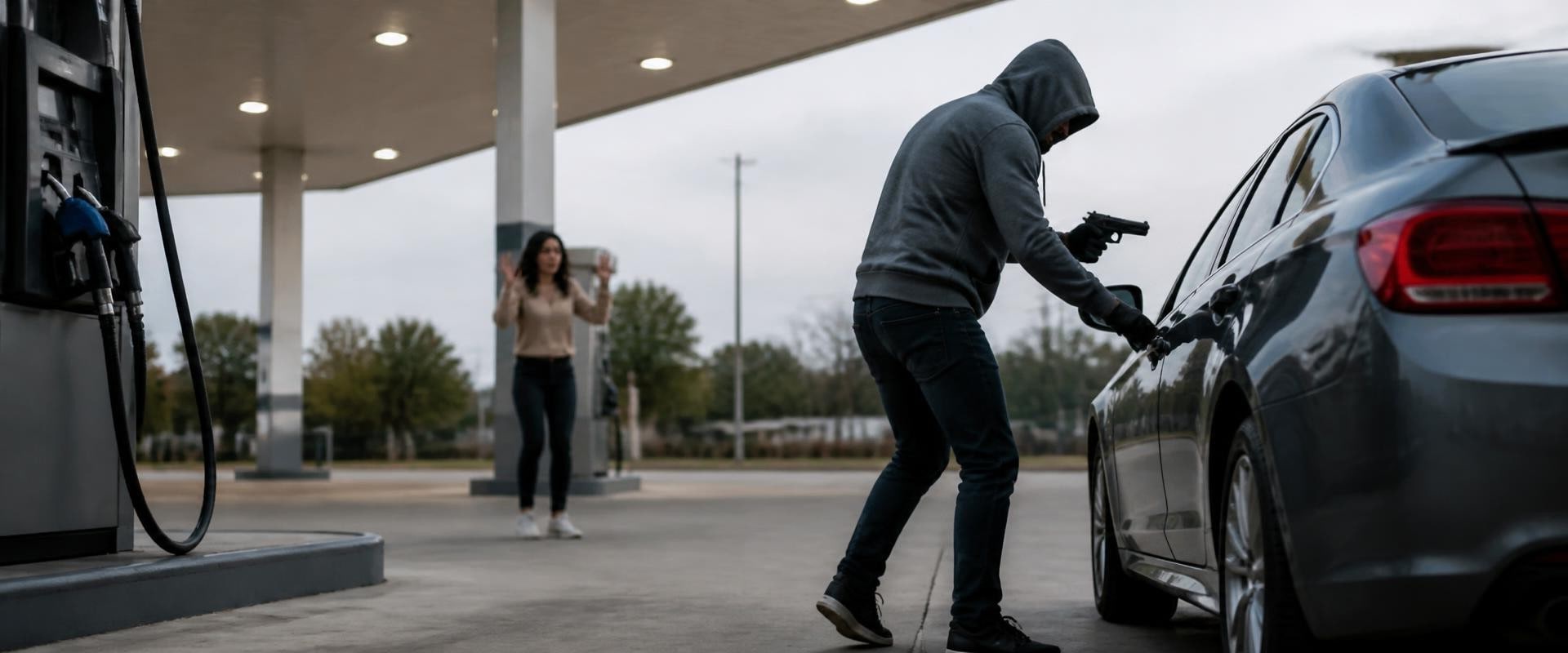
The fuel island is one of the most exposed places a driver can stand. You are outside your car, often with the door open, your attention split between the nozzle, the screen, and your phone. Keys may be in the ignition. A bag may be on the passenger seat. For offenders looking for a fast target, that moment is an opportunity.
Robberies and carjackings at the pump are not random flukes at many locations. They follow patterns, and whoever runs the station usually has seen them coming.
How pump crimes typically unfold
Pump-side crimes tend to fall into a few categories:
- Armed robbery: someone approaches while the driver is fueling and demands cash, a phone, or a wallet at gunpoint.
- Carjacking: an attacker forces the driver out and takes the vehicle, sometimes with passengers or children still inside.
- Sliding or "sneak" thefts: a thief crouches low, opens the passenger door on the far side, and grabs a purse or bag while the driver is distracted.
- Follow-home or follow-off robberies: an offender watches customers at the station and targets someone who appears to be carrying cash.
Each of these depends on cover, distraction, and confidence that nobody is watching.
The security that should be there
A station that knows its pumps attract crime can do a great deal to discourage it. Bright, working canopy lights eliminate shadows around the islands. Cameras aimed at every pump, with a recorder that keeps footage long enough to be useful, make offenders easier to identify and therefore less willing to act. A clerk with a clear view from the register can see trouble developing and call for help. Where incidents keep happening, a guard patrolling the lot during high-risk hours may be reasonable.
When these measures are missing at a location with a documented history of pump robberies or carjackings, the owner may be responsible for injuries that follow.
Prior incidents tell the story
Proof of what came before is often what decides these claims. Police dispatch logs may show repeated calls about robberies, stolen cars, or suspicious people at the pumps. Internal incident reports, employee statements, and earlier surveillance clips can show that management knew. Crime data for the immediate area can add context. If the station kept operating with dark islands and dead cameras despite that record, a judge or jury may conclude that the attack on you was foreseeable.
Injuries are often serious
Pump robberies and carjackings can involve guns, knives, or vehicles used as weapons. Victims may be shot, beaten, dragged, or run over. Even when physical injuries heal, many people experience lasting anxiety about driving at night, stopping for fuel, or being alone in parking lots.
Passengers can be harmed too. Children in the back seat during a carjacking, or a spouse waiting in the car during a robbery, may suffer injuries or lasting fear of their own, and they may have separate claims. Witnessing a violent crime against a family member can leave deep psychological scars, and treatment for that trauma is a legitimate part of the damages picture.
What compensation can cover
A negligent-security claim may help pay for emergency care, surgery, rehabilitation, and counseling. It can also address lost wages, reduced earning ability after a serious injury, and the emotional impact of the crime. Should the attack prove fatal, a wrongful-death suit may be open to relatives.
Property losses such as a stolen car or phone are typically handled through insurance, but the injury claim against the station is separate and focuses on the harm to the person.
Who may be liable
Depending on how the location is run, a claim may name whoever holds title to the land, the franchisee or operator responsible for day-to-day decisions, and in certain situations the fuel brand, if it controlled lighting, camera, or staffing standards.
Protecting your claim
Write down which pump you used and when, and save your receipt or card statement as proof you were there. Ask police for the report number. If you can return safely during the same time of night, photographs of the lighting can be useful. Most importantly, act quickly, because station video is commonly erased within days or weeks.
Talk with an attorney
The Haggard Law Firm's practice centers on people hurt because a business skimped on safety, and it has worked on nearly 500 such claims. Its biggest result, $102.7 million awarded to a shooting victim left paralyzed, set the national benchmark for negligent-security awards; that number is before deductions for fees and costs.
You owe the firm nothing unless it obtains compensation for you. Phone (305) 446-5700 to have a pump robbery or carjacking reviewed free. To learn more, visit: https://crimevictim.attorney/negligent-security/gas-station/
Attorney advertising. This is a general overview, not advice on your particular facts, and an initial inquiry does not create an attorney relationship. What happened in another case cannot predict what will happen in yours.