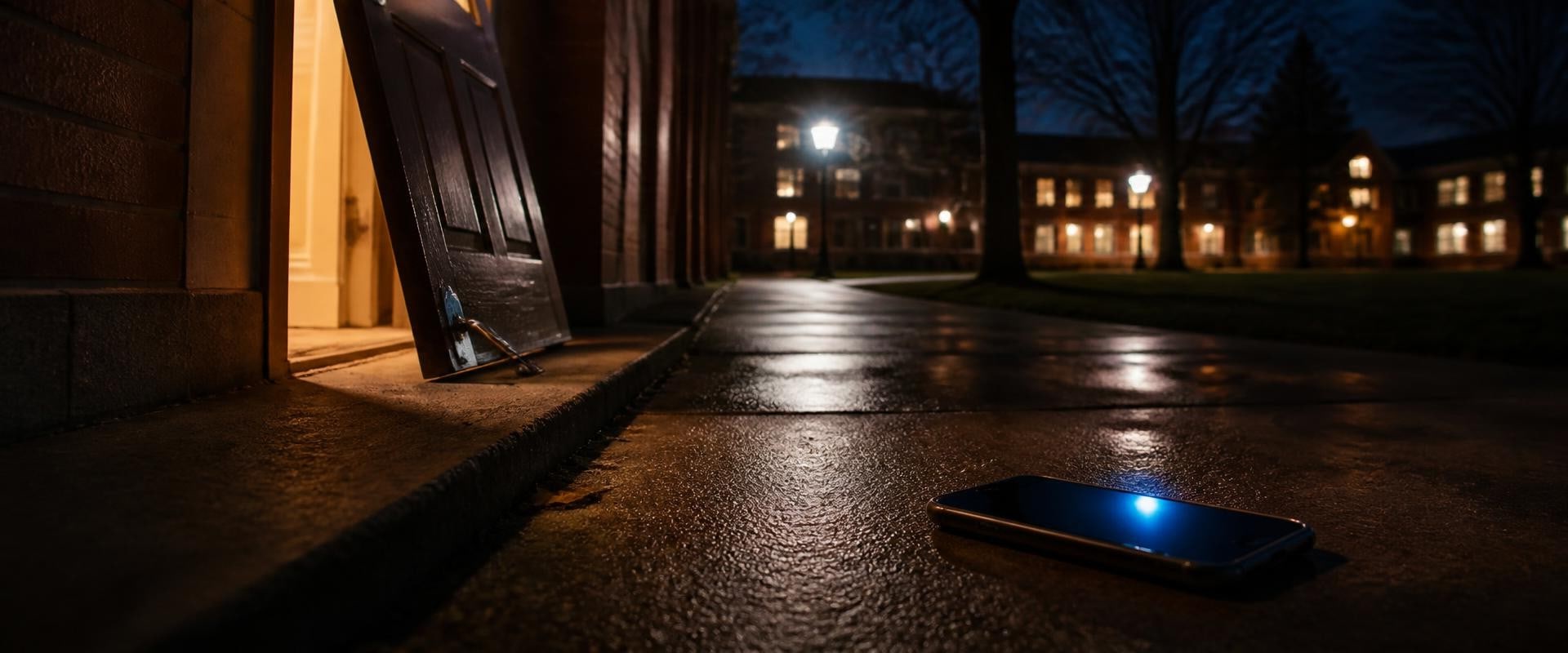
Most college assaults and shootings do not happen in a vacuum. Looking back, investigators often find a series of small failures that, taken together, gave an attacker an opening. A door that never latched. A path the grounds crew stopped lighting. A patrol schedule cut to save money. A warning that never went out.
Below are five lapses that recur whenever students are harmed on campus, and why each one can matter in a lawsuit.
1. Residence hall access that does not keep anyone out
Card-swipe systems and staffed front desks are supposed to make sure only residents and their guests get into dorms. In practice, doors are propped open with rocks or shoes, latches fail and go unrepaired for weeks, and side or stairwell exits are left unalarmed. Some schools never enforce sign-in rules for visitors at all.
When access control breaks down, an intruder can walk straight to a student's floor. Work orders for broken doors, alarm logs, and resident complaints often reveal how long a problem was left in place.
2. Lighting that leaves gaps in the dark
Campus walkways, parking lots, and the spaces between buildings are common settings for attacks on students, frequently late at night as people head home from libraries, labs, or social events. Burned-out fixtures, lights blocked by overgrown trees, and areas that were never lit at all give attackers cover.
Students and staff sometimes report these dark spots repeatedly. Records of those reports, along with facilities maintenance logs, can show that the school knew a pathway was dangerous and left it that way.
3. Too few officers and slow response
Campus police departments and contracted security teams are often stretched thin, particularly overnight and on weekends. A large campus may have only a handful of officers covering dorms, parking structures, and event spaces at once. Response times can lengthen dramatically when staffing is low.
Understaffing becomes especially significant when the school already knows about a crime problem. Choosing not to add patrols after a string of assaults can be a serious failure.
4. Staying silent about a known threat
Colleges often learn about threats before students do: a reported stalker, a series of assaults in one area, a person banned from campus, or credible warnings of violence. Students cannot protect themselves from dangers they are not told about.
Keeping quiet about an identified danger or a cluster of similar crimes deprives students of the chance to change routes, travel in groups, or stay away from a dangerous area. Internal emails, police briefings, and the timing of any alerts the school eventually sent can show what administrators knew and when.
5. Equipment allowed to fail
Locks, surveillance cameras, and emergency call stations, often called blue-light phones, are only useful when they work. On some campuses, call boxes have been out of service for months, cameras point at walls or record nothing, and locks are known to be faulty. A student who runs to an emergency phone that is dead, or who is attacked in a hallway where the camera has been broken for a semester, was failed by maintenance decisions made long before that night.
Patterns matter more than single lapses
One burned-out bulb or a single propped door does not automatically make a school liable. What tends to carry weight is a pattern: the same broken entrance reported again and again, a path where several students had already been attacked, an officer shortage the administration acknowledged and never fixed. Lawyers look for that history in maintenance systems, campus crime logs, student government minutes, and even student newspaper coverage, which sometimes documents complaints long before an attack.
Why these failures can create liability
Colleges control their residence halls, parking areas, walkways, and buildings, and they invite students to live and study there. That control brings a duty of reasonable security, especially once earlier attacks, burglaries, or other violence on the grounds have come to the school's attention. When a school ignores these basic protections and a student is harmed as a result, the institution may be responsible.
Students living in private complexes near campus face the same kinds of failures, and the companies that run those buildings can be held accountable as well.
What can be recovered
Claims may seek payment for physical and psychological treatment, the academic and career setbacks that follow a serious injury, and damages for trauma. A family that loses a student may pursue wrongful-death compensation.
Counsel for injured students and families
The Haggard Law Firm draws on nearly 500 negligent-security cases. Its largest result, $102.7 million, exceeds what any other American jury has awarded in a negligent-security trial; that gross figure precedes payment of fees and costs.
Students and parents owe no attorney's fee unless money comes back to them. A private, cost-free review is available through (305) 446-5700.
Attorney advertising. The failures above are general examples and do not amount to legal advice about a particular campus. Getting in touch with the firm creates no attorney relationship on its own. One case's outcome cannot predict another's.