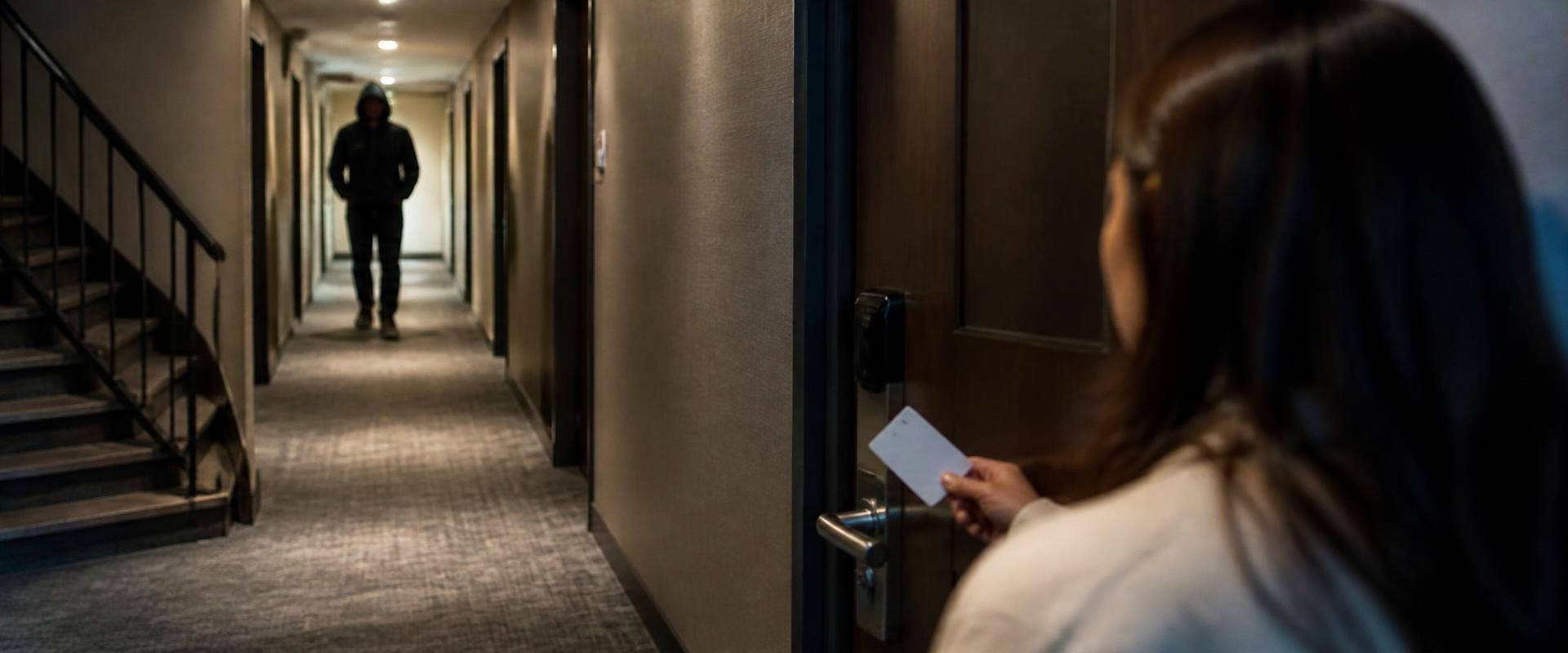
When a guest is attacked at a hotel, the investigation that follows rarely uncovers a single mistake. More often, it reveals a property where several layers of protection had quietly failed, and where management either knew or should have known. Six failures show up again and again in hotel and motel cases. Each one is worth understanding on its own.
Failure 1: Locks and key cards that can be beaten
The room door is a guest's last line of defense. Problems range from worn latches that do not catch, to deadbolts that were never repaired, to electronic key-card systems with known vulnerabilities. Some properties never deactivate old cards, leaving former guests or employees with working access. Others hand out duplicate keys without checking identification. A lock that can be bypassed is not really a lock.
Failure 2: Cameras that do not record what matters
Surveillance in lobbies, hallways, stairwells, and parking areas can deter crime and capture evidence when it happens. But many systems are partial, broken, or never reviewed. Cameras may cover the front desk and nothing else, or record over themselves before anyone looks. When a guest is attacked in an unmonitored stairwell, the gap is often obvious in hindsight.
Failure 3: Anyone can walk in
Many properties allow free movement through side entrances, pool gates, and stairwells at all hours. Without keycard-only entry after dark, a staffed desk, or locked secondary doors, people who are not registered guests can roam the building. Some go looking for unlocked rooms or guests walking alone.
Failure 4: No security at a property that needs it
Not every hotel requires guards. A property that has already experienced robberies, assaults, or other violent incidents is different. Choosing to operate without any security staff after that history can be a serious failure, especially overnight, when the front desk may be staffed by a single clerk.
Failure 5: Dark lots and outdoor corridors
Motels in particular often have rooms that open directly onto exterior walkways and parking lots. Poor lighting in those areas lets attackers approach unseen and gives guests no warning. Travelers unloading bags near midnight make tempting targets for holdups and car thefts.
Failure 6: Looking away from known crime
Prior assaults, robberies, and drug activity on the property are warning signs that a reasonable operator cannot ignore. Hotels sometimes tolerate ongoing problems in certain rooms or areas because addressing them costs money or bookings. If a paying guest is later hurt, that ignored pattern often becomes the centerpiece of the lawsuit.
How these failures support a claim
Lodging businesses owe guests reasonable security, and they can be held liable when they ignore foreseeable risks. Each failure above is a way a property can fall below that standard. Evidence usually includes key-card audit trails, maintenance records, camera system logs, staffing schedules, police calls to the address, and internal incident reports.
Failures rarely happen alone
In practice, these six problems tend to feed one another. A broken side door matters more when no camera watches it. A dark stairwell is more dangerous at a property where nobody patrols. A known drug problem becomes far riskier when key cards are handed out without checking who is asking.
That overlap is why investigators examine the whole property rather than a single defect. They may walk the grounds at night to see what lighting actually looks like, compare camera placement against where incidents occurred, and review how many employees were on duty during the hours when crime tended to happen. They also look at what the hotel did after earlier incidents: whether repairs were ordered, whether policies changed, and whether anyone followed through.
A security expert can then explain to a judge or jury which reasonable measures were missing and how they likely would have prevented the attack. When several gaps line up, the argument that the hotel simply could not have stopped the crime becomes much harder for the property to sustain.
The companies behind the property
Ownership, day-to-day management, brand oversight, and contracted guarding are often split among separate businesses, and each split can matter to who answers for a lapse. Brand standards and franchise agreements sometimes require specific security measures, and failing to follow them can matter.
Recovery for guests and families
Injured guests may seek the cost of medical care, lost earnings, and damages for the trauma of the attack. Families of guests who are killed may pursue wrongful-death claims.
The Haggard Law Firm has stood beside close to 500 negligent-security clients. In one of those matters, jurors awarded $102.7 million after a shooting at a combined Miami nightclub and shopping property, a figure unmatched by any other verdict of its kind nationwide. That sum is listed gross.
There is nothing to pay unless the firm wins. For a confidential, no-cost review of a hotel incident, phone (305) 446-5700.
Attorney advertising. The six failures above are illustrations, not guidance tailored to you, and reading them creates no attorney relationship. A prior verdict does not predict the next one.