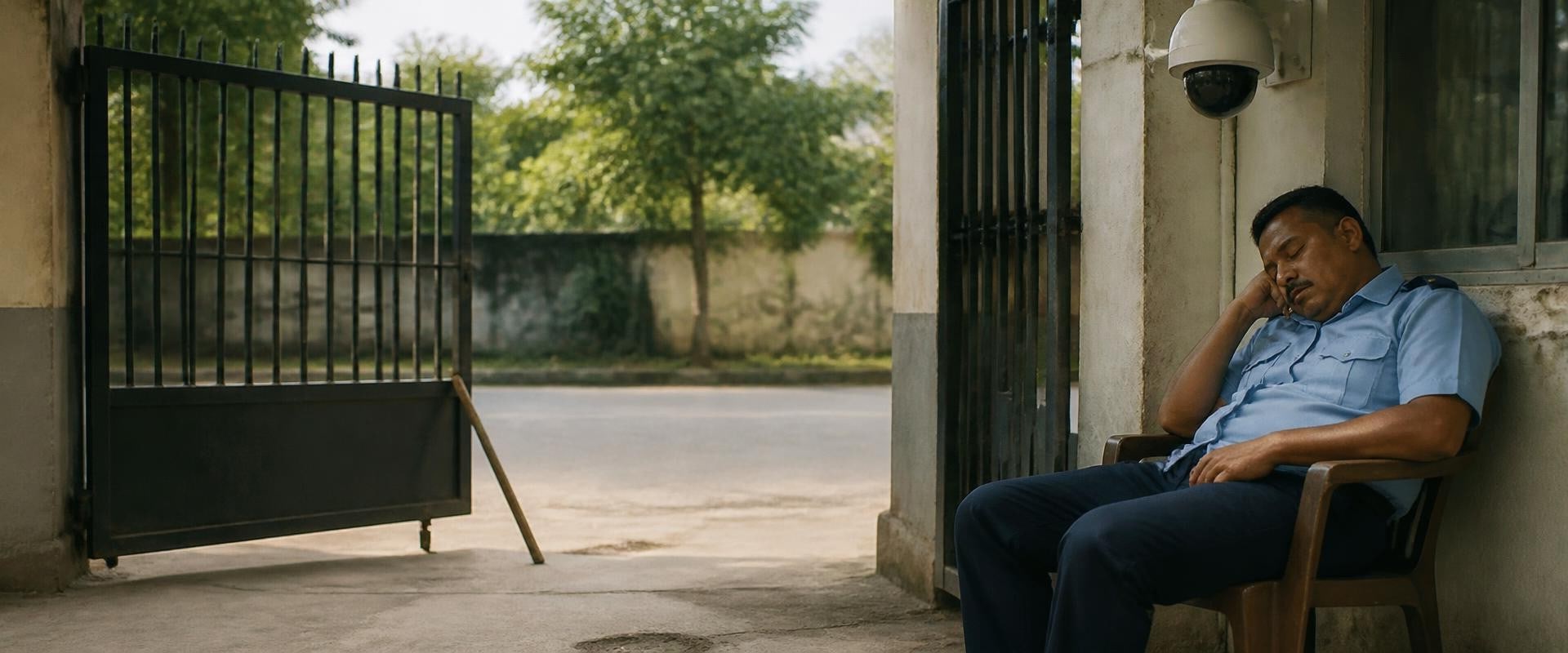
"Inadequate security" can sound abstract, like a phrase from a legal brief. On the ground, it is usually very concrete. It is the guard booth with no one in it at 2 a.m. The camera dome that has no camera inside. The lobby door held open with a rock because the card reader stopped working last spring.
Every negligent-security case has its own facts, but the same handful of failures appear again and again. Recognizing them can help victims and families understand whether what happened to them might support a claim.
1. Missing, sleeping, or untrained guards
Some properties clearly need guards because of their size, the people they draw, or their history of crime. When such a property has no guards at all, the gap is obvious. Just as often, though, a guard exists on paper but not in practice. The officer was off the property, asleep in a car, glued to a phone, or never trained to respond to a threat. A security company billing for coverage that it did not actually deliver can share responsibility with the owner who hired it.
2. Entry points anyone can walk through
A perimeter is only as strong as its weakest entrance. Months-long gate outages, doors wedged open, and latches that no longer catch turn a secure building into an open one. Repair requests and resident complaints often show how long these problems went unaddressed.
3. Darkness where people walk
Parking lots, stairwells, breezeways, and walkways are where attacks often happen, and they are where lighting most often fails. Dead fixtures hide attackers and leave victims blind to what is coming. Lighting is inexpensive to fix, which makes a long-ignored outage hard to justify.
4. Cameras that are broken, fake, or ignored
Surveillance only helps if the system records and someone pays attention. Some properties mount dummy cameras for appearance. Others let real systems fall into disrepair or never assign anyone to watch the monitors. The result is a false sense of safety for residents and customers, and often no footage when it is needed most.
5. Access control that exists only in theory
Key fobs, call boxes, and front-desk screening are supposed to limit who gets inside. When fobs are never deactivated, call boxes buzz in anyone who presses a button, or the front desk is left unstaffed, strangers can move through a building as freely as the people who live there.
Visitor logs and fob data can later show who entered and when, which makes these systems valuable as evidence as well as safeguards.
6. A crime history the owner chose to ignore
This failure often ties the others together. When an owner knew about past shootings, robberies, or assaults and still did nothing to improve security, the next crime becomes far more foreseeable, and the owner's inaction far harder to defend. In many cases, this documented history is the heart of the claim.
Some owners react to crime only by posting signs or mailing letters telling tenants to be careful. Notices like that can actually prove the owner understood the danger.
How these failures connect to liability
Owners generally owe the people they invite onto their property a duty of reasonable care. Liability attaches when a crime was predictable and the precautions fell below what a prudent owner would take. Each of the failures above is a way an owner can fall short of that standard.
Who may be accountable
Depending on the facts, responsibility may rest with the property owner, the company managing the property, and any security firm under contract. A full investigation looks at each one.
Recording what you see
If it is safe, photograph broken gates, dark areas, damaged locks, and cameras as soon as possible after an incident. Repairs often follow serious crimes quickly. A lawyer can then request maintenance logs, staffing records, footage, and police call data. Surveillance video in particular is often overwritten within days or weeks.
Neighbors and coworkers can help too. Ask whether they reported the same broken gate or dark stairwell, and whether they kept copies of emails or texts to management. Several residents describing the same unaddressed problem can carry real weight.
Compensation and the firm's record
Victims may recover medical costs now and in the future, lost earnings and earning capacity, and damages for pain and emotional trauma. A grieving family can recover burial and funeral bills, the support the person provided, and the companionship and direction they offered.
The Haggard Law Firm's case list in this area numbers almost 500. In one, a patron shot because of inadequate security and left paralyzed received a $102.7 million verdict, a figure no other U.S. negligent-security verdict has matched. That result is reported gross.
Legal fees are due only out of a recovery. To have your case reviewed in confidence and without charge, ring (305) 446-5700.
Attorney advertising. These illustrations are generic, not advice for your circumstances, and they do not make you a client. Earlier verdicts do not guarantee later ones.